Tuning
Pianos require regular tuning in order to maintain the correct pitch; at least once a year have your piano fully tuned. When Ralph Thorn tunes your piano, he will advise on any necessary and recommended adjustments or repairs which will allow the piano player to fully enjoy the instrument’s potential, and maximize the enjoyment of playing and listening. This will help maintain the value of your investment in the piano and in lessons. I tune aurally, meaning my ears can tell me when a note is in tune, starting from a pitch set by tuning fork or electronic pitch device and then using mathematical relationships between notes. That’s how I was trained, and is how most concert tuners tune pianos. Some tuners rely on electronic tuning aids to set the pitch for each note, and some electronic tuning devices and programs are exceptionally good (also expensive), other phone apps are cheap and are unfortunately only suitable for guitars and perhaps electronic organs. I also have high-quality electronic tuning aids that I might use in noisy settings or to prove tunings.
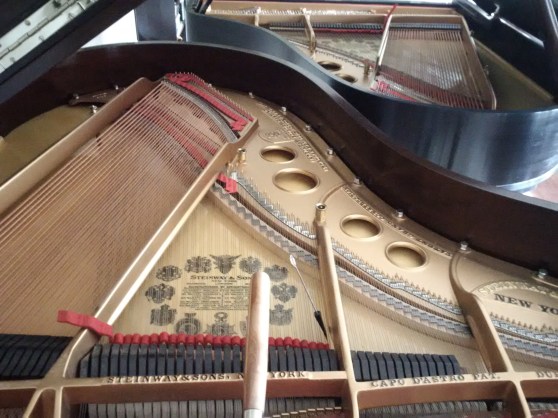
Photo above: tuning two Steinway grands
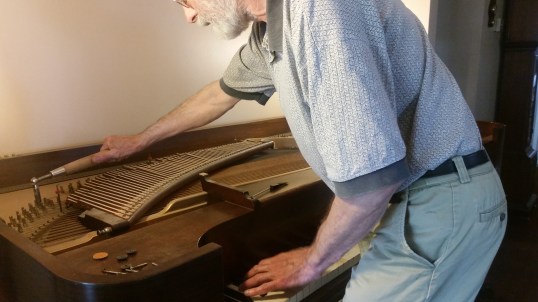
Shown below: tuning a 19th century square piano (square grand) rebuilt by Ralph Thorn in 1979
Repairs
Tuning is not all your piano requires. A piano contains as many as 12,000 parts, any of which may need repair or replacement in time. After some years of use, dimensions of various felt, cloth and wood parts will change, requiring some adjustment and eventual replacement to allow the mechanism to function as it was designed. You can expect that some parts will wear out or break under stress of repeated strong use, or if subjected to the effects of high temperature, low or high humidity, or visits by moths and mice.
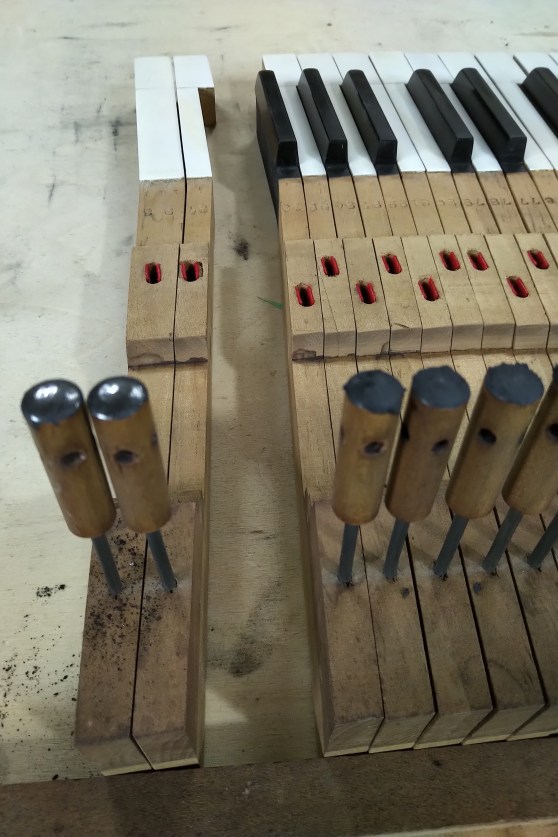
Shown below: burnishing (polishing) the new graphite applied to the tops of key capstans, the two on the left are now burnished and almost friction-free for a smooth feel in performance, a small job yielding great results, particularly on an older upright. This photo also shows new cloth bushings, using carefully size-selected bushing cloth to achieve correct friction at the balance point. I use a custom-made mortising jig to correctly position and size the holes for the cloth bushings.
Rebuilding
Rebuilding is a full-scale return to original condition, or even better than new. This is a lengthy process, undertaken only after a thorough evaluation of the entire piano and its value as a musical instrument, and thus as an investment. A complete rebuilding of an upright or grand will likely be far less expensive than replacing the piano with a fine quality new instrument. At the time of rebuilding, many customers elect to have the casework refinished since it is already out of the house and in pieces. Ralph Thorn Pianos does not do case refinishing but will facilitate that process. Ralph Thorn Pianos has connections to professional and reputable case finishers.
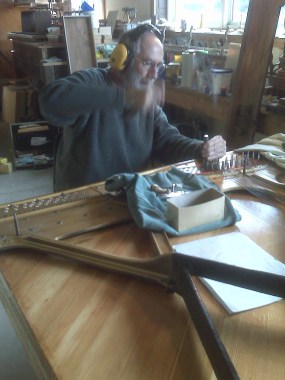
Shown right: re-stringing a 1920 upright piano
See the Portfolio page for examples of rebuilding operations.
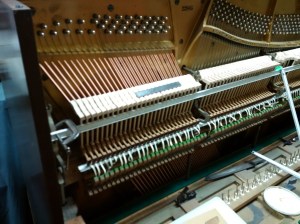
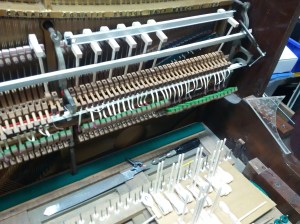
Shown below: installing new hammers on the action of a 1910 Heintzman upright
Special Services Offered
– piano appraisal for purpose of sale, purchase or insurance
– touch regulation to maximize tone and performance
– PianoLifeSaver system installations
– ergonomic re-design
– straight-strung piano rebuilding
– historical material use, including leather hinges and age-appropriate wire
– structural re-design for musical or aesthetic reasons
– reed organ and player piano repairs
 Ralph Thorn Pianos